
Table of Contents
- EV Charger Installation Cost Overview
- Level 2 EV Charger Installation Cost Breakdown
- EV Charger Electrical Panel Upgrade Cost
- EV Charger Installation Time and Process
- Choosing a Licensed EV Charger Installation Electrician
- Key Cost Factors and How to Get an Accurate Quote
- Rebates, Tax Credits, and Incentives
- Frequently Asked Questions
Last Updated: October 14, 2026
EV Charger Installation Cost Overview
Installing an EV charger at home involves more than buying hardware. The real cost depends on electrical infrastructure, distance from your panel, permitting, and whether upgrades are needed.
When budgeting for EV charger installation cost south in Florida, you’re paying for three components: the charger unit, the electrical work to support it, and permitting and inspection.
What’s Included in Installation Pricing
A complete installation includes charger hardware, circuit installation, conduit and wiring runs, breaker box modifications, permit fees, and inspection. Labor typically accounts for 40-60% of the final cost.
Your electrician will assess panel capacity, measure the distance to your charging location, evaluate existing wiring, and determine whether upgrades are necessary.
Level 2 EV Charger Installation Cost Breakdown
Level 2 chargers are the residential standard, delivering 240 volts and faster charging than 120-volt outlets.
Charger Hardware vs. Labor Costs
The charger unit typically represents 20-35% of total installation cost; the remaining 65-80% covers labor, materials, permits, and inspections.
Labor costs reflect the electrician’s expertise, licensing, and time. A licensed, insured electrician carries overhead that unlicensed workers do not, and that difference matters when something goes wrong. Turner Unlimited Electric LLC’s team brings over 10 years of experience.
Wiring, Conduit, and Circuit Requirements
Wire gauge, conduit type, and circuit requirements depend on the distance from your panel to the charger and the amperage it draws.
Conduit protects wiring from damage and exposure. Outdoor installations typically require Schedule 40 PVC or rigid steel conduit, which costs more than indoor flexible conduit. A 20-foot run costs far less than a 100-foot run.
Always verify the exact wire gauge and conduit type your electrician recommends. Some installers cut corners with undersized wire, which creates fire hazards and may fail inspection. Your electrician should provide a detailed materials list before starting work.
EV Charger Electrical Panel Upgrade Cost
Many homeowners discover their panel cannot safely support an EV charger without upgrades, especially in older homes or those with multiple high-demand appliances. But a full service upgrade isn’t always required, load management devices can sometimes let you add a 40- or 48-amp charger to an existing 100- or 150-amp panel.
When You Actually Need a Panel Upgrade
Your panel has a maximum amperage capacity. Adding a 40-amp dedicated EV circuit requires available breaker slots and sufficient overall capacity.
A load calculation determines your actual demand, following the method in Article 220 of the National Electrical Code (NEC), which assigns demand factors to load types rather than adding up every breaker.
If your panel lacks capacity, you generally have three paths:
- Service upgrade, replace the panel and possibly the meter base and service entrance conductors to move from 100 or 150 amps to 200 or 400 amps. Most expensive option; requires utility coordination.
- Load management device, install a smart splitter or energy management system (for example, the DCC-9 or Wallbox Power Boost) that pauses the charger when total draw approaches the service limit. Lets you keep an existing panel and add a 40- or 48-amp charger for a fraction of a service upgrade.
- Derate the charger, set output lower (for example, 32 amps on a 40-amp circuit) so the calculated load fits the existing service. Cheapest path, but slower charging.
What a Panel Upgrade Actually Costs
Panel upgrade pricing in this region breaks into several line items:
- Panel and breaker hardware: a 200-amp main breaker panel commonly runs in the low four figures for equipment alone.
- Labor for the swap: a straightforward replacement in an accessible location is usually a one-day job for a licensed electrician and a helper.
- Service entrance and meter work: if the service mast, meter base, or utility drop must be replaced, cost rises and the utility may need to disconnect and reconnect power.
Because these variables stack, a panel upgrade can cost several times a simple charger circuit. That’s why the load calculation matters, it tells you whether you need the upgrade or a load management device will do.
Distance from Electrical Panel to Charger Location
The farther your charger is from your panel, the longer the wire run and the more conduit required.
Long runs also create voltage drop concerns. NEC Article 210.19(A) and Chapter 9 notes recommend keeping voltage drop under about 3% on branch circuits.
Some installations require intermediate conduit runs, pull boxes, or underground boring under driveways and walkways, adding labor and material.
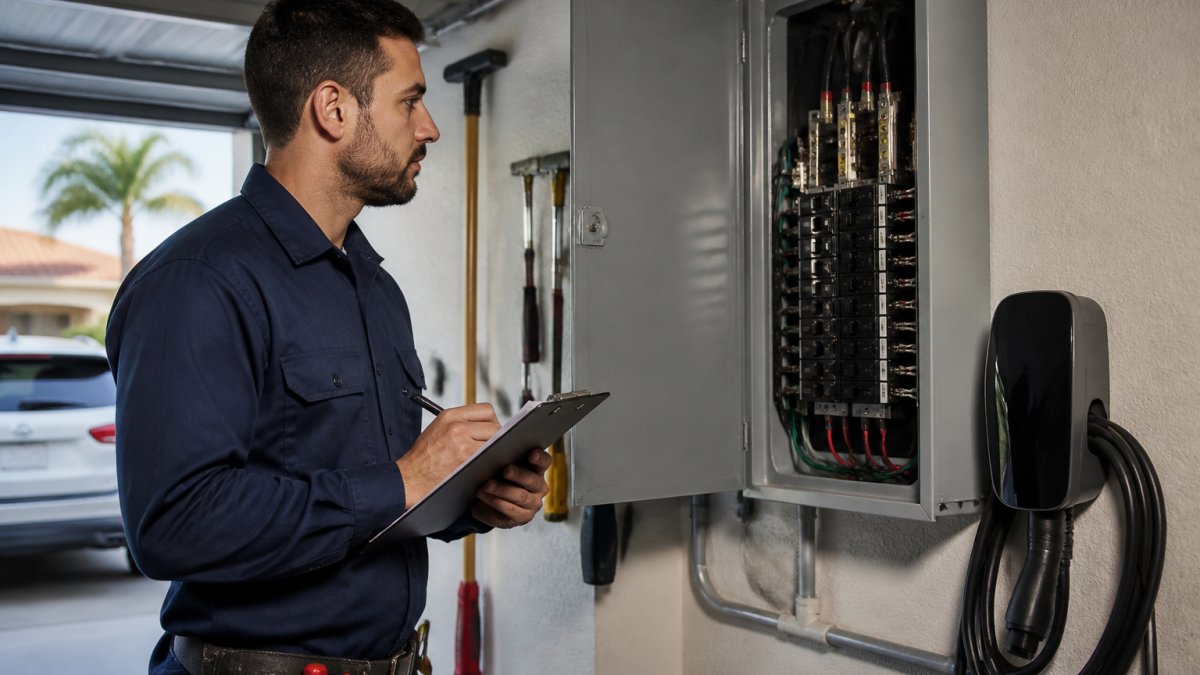
Ask your electrician to show you the load calculation worksheet, not just tell you the result. A written calculation that follows NEC Article 220 is the difference between a quote based on math and a quote based on a guess.
EV Charger Installation Time and Process
The timeline depends on electrical complexity, permitting, and inspector availability. Most straightforward installations take 1-3 days of actual work, but permitting and inspection can extend the total timeline by weeks.
Permits and Inspections in South Florida
South Florida jurisdictions require permits for EV charger installations, and requirements vary by city and county. Some municipalities simplify the process; others require detailed electrical plans and multiple inspections.
Inspection ensures your installation meets the National Electrical Code and local amendments. An inspector verifies wire sizing, conduit, breaker ratings, grounding, and bonding.
Never skip permits to save money. Unpermitted work voids your home’s electrical warranty, creates liability if someone is injured, and fails inspection when you sell your home. Buyers’ lenders require permitted electrical work, and unpermitted installations can kill a sale.
Garage vs. Outdoor Installation Considerations
Garage installations typically cost less: the charger is protected from weather, closer to the panel in most homes, and wiring runs are shorter.
Outdoor installations require weather-resistant conduit, NEMA 3R or 4X rated chargers, and protection against moisture and temperature extremes. Concrete boring or trenching adds labor and material costs, and longer wire runs further increase expense.
Choosing a Licensed EV Charger Installation Electrician
Your electrician’s qualifications directly impact installation quality, safety, and warranty protection. An unlicensed or uninsured installer may be cheaper, but you absorb all liability and risk.
What to Ask Before Hiring an Electrician
Ask for detailed written quotes itemizing charger hardware, labor, conduit and wiring materials, permit fees, and inspection costs.
Inquire about their experience with EV charger installation cost south in Florida and local requirements.
Ask about warranty coverage on labor and materials. Turner Unlimited Electric LLC backs all installations with a 2-year limited warranty.
Verifying Licensing and Insurance
Verify your electrician’s license through the Florida Department of Business and Professional Regulation. A valid license means they’ve passed exams demonstrating electrical knowledge and safety compliance.
Confirm they carry liability insurance and workers’ compensation coverage. If an electrician is injured on your property or damages your home, their insurance protects you.
Key Cost Factors and How to Get an Accurate Quote
Multiple variables influence your final cost. Understanding them helps you evaluate quotes and avoid low-ball estimates that hide unexpected charges.
Load Calculation and Electrical Capacity Assessment
A load calculation analyzes your home’s electrical demand. Your electrician reviews main service size, existing circuit loads, and your charger’s amperage to determine whether your panel can accommodate a new 40-amp circuit or needs a service upgrade.
This assessment reveals the true scope of work. A home with 200-amp service and available capacity costs far less than one requiring a service upgrade to 400 amps.
Condo and Multifamily Installation Challenges
Condo and apartment installations present unique challenges: the electrical panel is often in a common area, HOA or property management approval may be required, and shared infrastructure may limit available capacity.
Some condos restrict installations to specific locations or require hardwired chargers; others require shared systems serving multiple units. These restrictions increase complexity and cost.
| Installation Factor | Impact on Cost | Typical Consideration |
|---|---|---|
| Panel capacity available | High | Upgrade needed or not |
| Distance from panel to charger | High | Wire run length and gauge |
| Outdoor vs. garage location | Medium | Weather protection requirements |
| Existing wiring condition | Medium | Replacement or reuse possible |
| Permit complexity | Medium | Local jurisdiction requirements |
| Condo or multifamily building | High | Common area access and restrictions |
Rebates, Tax Credits, and Incentives
Federal and state incentives reduce your net cost, but caps, eligibility, and paperwork requirements change, a rebate you assume you qualify for may not apply to your address or installer. Here’s the current landscape, with caveats to verify before you budget.
Federal Incentives
The federal tax credit for EV charging equipment and installation, often called the Alternative Fuel Vehicle Refueling Property Credit under Internal Revenue Code Section 30C, covers 30% of the cost of qualified equipment and installation (Alternative Fuel Vehicle Refueling Property Credit). The IRS publishes the eligibility details and the census tract lookup tool; check the IRS guidance on the alternative fuel vehicle refueling property credit for the current form and instructions.
The credit applies to the charger plus installation labor and materials, not just hardware. A $2,500 job can generate a $750 credit, subject to the $1,000 cap. Keep your itemized invoice, a lump-sum receipt that doesn’t separate equipment from labor can complicate the claim.
State and Utility Programs
State-level incentives in this region have historically been limited and change yearly. Rather than rely on one program, check three sources in order:
- Your electric utility. Many offer residential EV charger rebates, often a few hundred dollars, sometimes conditioned on enrolling in a managed charging or off-peak program, meaning the utility may control when your charger runs during peak events. Ask whether the rebate requires a networked charger and whether it covers installation or only hardware.
- Your municipality or county. Some offer reduced or no-cost permits for EV charger installations, or pilot grant programs. Usually small but easy to claim.
- Your vehicle manufacturer or charger brand. Some automakers and charger manufacturers offer installation credits or discounted hardware with a vehicle purchase, which can stack with the federal credit.
The Department of Energy’s Alternative Fuels Data Center maintains a searchable database of federal, state, utility, and local incentives by ZIP code. Use it as a starting point, then call the utility or program administrator directly to confirm the current terms, databases lag program changes.
How to Stack Incentives Without Losing Them
Incentives rarely stack cleanly. Rules of thumb:
- Federal credit is claimed on your tax return; utility rebates are usually paid as a check or bill credit. You can generally use both, but the rebate may reduce the cost basis you claim on your taxes. Ask your tax preparer.
- Some utility rebates require pre-approval before installation. Install first and apply later, and you may be denied. Confirm the sequence.
- Permitted work is almost always a condition. Unpermitted installations typically disqualify you from both utility rebates and the federal credit.
The single most common mistake is assuming the federal credit is automatic. It is not, the census tract requirement, the $1,000 cap, and the need for an itemized invoice all trip people up. Verify eligibility before you sign a contract, not after.
Net Cost After Incentives
Because incentives vary by address, utility, and tax situation, your net cost is a range, not a number. A homeowner qualifying for the full federal credit and a utility rebate may see the effective cost of a straightforward Level 2 installation drop meaningfully; one in a non-eligible census tract with no utility program pays full price.
Frequently Asked Questions
How much does EV charger installation cost?
Total EV charger installation cost depends on charger type, electrical panel capacity, distance from the panel to installation location, and whether upgrades are needed. Level 2 chargers require a dedicated 240-volt circuit and wiring, with pricing varying based on existing electrical infrastructure. Get a quote from a licensed electrician who can assess your specific home’s electrical conditions and provide an accurate estimate.
Does installing an EV charger require an electrical panel upgrade?
Not always. If your electrical panel has available capacity and a dedicated circuit can be installed, an upgrade may not be necessary. However, older homes or those with limited panel capacity often need upgrades to safely support a Level 2 charger. A licensed electrician performs a load calculation to determine if your panel can handle the additional demand without exceeding its capacity.
How long does EV charger installation take?
Installation timelines vary based on complexity. Simple installations in homes with adequate electrical capacity may take one day. More complex projects requiring panel upgrades, longer wire runs, or conduit installation take longer. Permitting and inspection timelines also affect the total project duration. Your electrician can provide a realistic timeline after assessing your specific electrical conditions.
What should I ask an electrician before hiring them for EV charger installation?
Ask about their experience with EV charger installations, licensing status and insurance coverage, warranty on workmanship, whether they handle permitting and inspections, and how they determine if a panel upgrade is needed. Request references and verify they understand local electrical codes.
Are there tax credits for EV charger installation?
The federal government offers tax credits for home EV charger installation. Eligibility and credit amounts depend on income limits and charger specifications. Some states and utility companies also offer rebates or incentives. Check current federal and local programs before installation to understand what credits apply to your situation and ensure your charger meets all requirements.
What factors affect the cost of installing a home EV charger?
Key cost factors include the distance from your electrical panel to the charger location, existing electrical panel capacity, whether wiring and conduit need replacement, if a dedicated circuit must be installed, local permitting and inspection fees, and whether the installation is indoors or outdoors. Older homes with outdated electrical systems typically face higher costs due to necessary upgrades or additional safety measures.